
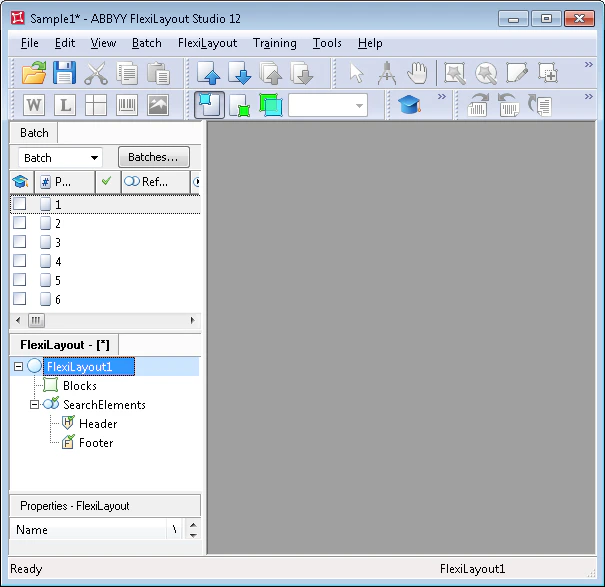
By default, FlexiLayout Studio names the new FlexiLayout FlexiLayout1.
Screenshot of the FlexiLayout tab of the FlexiLayout Properties dialog box in ABBYY FlexiLayout Studio showing the default name FlexiLayout1.
Rename the FlexiLayout to a descriptive name. This name also appears in ABBYY FlexiCapture when you create a FlexiCapture FlexiLayout from it.
1

Open the FlexiLayout properties

Double-click the FlexiLayout name (FlexiLayout1), or right-click the FlexiLayout and select Properties… on the shortcut menu.
2

Rename the FlexiLayout

In the Name field, type a new name, such as RegistrationForm.
3

Specify the pre-recognition parameters

  • From the Text languages list, select English (the documents are in English).
  • Select Typographic in the Text type group (the default). The form was not produced on a dot-matrix printer or typewriter.
  • In the Mode group, select Fast or Normal pre-recognition mode, depending on image quality. The sample images are good quality, with no noise and almost no small print, so select Fast mode. Fast mode speeds up pre-recognition in both FlexiLayout Studio and FlexiCapture.
4

Set the multi-page parameters

The document has one page, so specify 1 for both Minimum number of pages and Maximum number of pages.
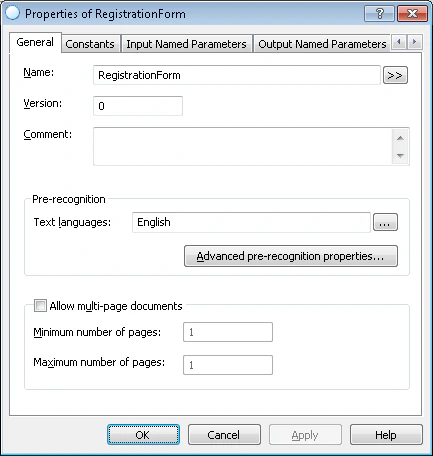
Screenshot of the FlexiLayout Properties dialog box in ABBYY FlexiLayout Studio showing the renamed RegistrationForm FlexiLayout with English text language, Typographic text type, Fast pre-recognition mode, and minimum and maximum page counts set to 1.
Delete the predefined Header and Footer elements from the FlexiLayout. A single-page form has no document boundaries to detect. Header and Footer elements normally help FlexiLayout Studio detect where documents begin and end. If it cannot find both when matching the FlexiLayout, it separates documents by the maximum number of pages, which is 1 in this example.